Backway´s Physical Therapy, PLLC
Services
- reestablishing joint range of motion and ability to perform functional activities for people who have arthritis
- improving posture and mobility for people with scoliosis and excessive kyphosis
- helping athletes achieve greater endurance, flexibility, coordination, thus enhancing sports performance.
- Initial Physical Therapy Evaluations often include tests and measurements for range of motion, strength, sensation and reflexes, posture and alignment, balance, walking patterns, and provocation tests to delineate causes of nerve pain.
- This technique is often used in the treatment of headaches, fibromyalgia and sacral/low back pain.
- SI is especially useful for treating scoliosis; excessive kyphosis (including Scheuermann’s: http://en.wikipedia.org/wiki/Scheuermann's_disease); complex biomechanical and orthopedic disorders (clients with pain and loss of motion in 3 or more areas of the body); the late effects of trauma (injuries) and chronic pain which has not responded to other forms of treatment.
- This technique is especially useful in the treatment of fibromyalgia, chronic pain and arthritic conditions.
- This technique is especially useful in the treatment of trauma (auto accidents, falls, multiple surgeries); complex biomechanical disorders (clients with pain and loss of motion in 3 or more areas of the body) and chronic pain which has not responded to other forms of treatment.
Physical Therapy:
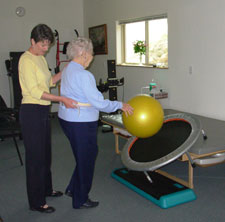
Generally, Physical Therapy aims to restore an individual’s optimal functional level when it has been limited by injury, illness, surgery, or chronic pain. Physical Therapy utilizes a combination of procedures like soft tissue and joint mobilization, neuromuscular reeducation, and therapeutic exercise and modalities (ultrasound/heat, cold, and electrical therapies) to achieve this goal. Some examples of how Physical Therapy may help include:
Thank you for sharing your knowledge with me and giving me so many valuable tools to work with. I’m doing really well (3 months after finishing PT); still living life without Advil!
At our clinic, clients are evaluated and treated only by state-licensed Physical Therapists; we do not employ assistants, technicians, or aides. In addition to their college education and medical internships, our PT’s keep pace with advances in our field by attending Continuing Education Seminars. In most cases, our dedicated therapists are awarded more than double the required hours of education each year.
Techniques Defined:(techniques are listed alphabetically)
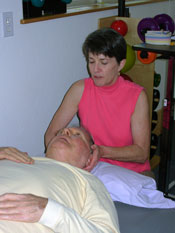
Cranio-Sacral Therapy (CST): This technique is also known as Cranio-Sacral Osteopathy, and is widely taught in the US through Dr. John Upledger, DO, to a variety of allied medical practitioners (www.upledger.com). Practitioners who are schooled in this technique use their hands to assess the subtle movements and rhythms at the cranium and the sacrum, and then use these rhythms to improve alignment and movement through the head and spine. Skilled practitioners can also use these techniques to treat problems in the trunk, arms and legs.
Joint Mobilization Techniques: Manually applied techniques to gain range of motion and reduce pain in the joints of the spine, or in the arms, hands, legs and feet.
Meeks’ Method Exercises for Osteoporosis: (http://www.sarameekspt.com)
Developed by Sara Meeks, PT, this method of exercise and movement reeducation is used to strengthen postural muscles and improve the thoracic kyphosis alignment in clients with Osteoporosis or Scheuermann’s Kyphosis.
WOW. This is the way PT should be! Forget those noisy machines and "formula" PT.
MFR: This technique is an offshoot of Osteopathy. It involves the practitioner feeling for restrictions in the myofascia and using their hands to guide the tissues gently towards improved mobility and a release of the restrictions. When done properly, this technique promotes greater ease of movement with less pain.
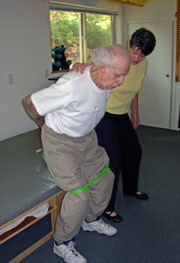
Neuromuscular Reeducation (NMR):
When a person is injured, their body will change its movement patterns and postural alignment to avoid pain. This is called “accommodation” and, if it goes on for more than a few days, it can lead to the development of tightness in the joints and holding patterns that will eventually cause poor postural alignment. In this situation, it is as if the person’s body “forgets” how to move and how to achieve a normal position.
The term NMR is used to describe any of a number of experiential techniques that are used to assist clients in relearning how to move their bodies in functional ways, and how to know when their bodies are in a “normal” position (called neutral).
Soft Tissue Mobilization (STM): Like MFR, this technique uses a practitioner’s hands to mobilize or release tight myofascial tissues in the body. The main goal of STM is to improve joint range of motion.
Structural Integration (SI):
Originated by Dr. Ida P. Rolf, and nick-named “Rolfing,” Structural Integration is a combination of techniques whose overall goals are to improve the entire postural balance of the body during static and dynamic states (standing, sitting or moving). The original school of Structural Integration was the Rolf Institute (www.rolf.org), but numerous other certified schools now exist, which teach variations of Dr. Rolf’s original “recipe.” (Note: Ms. Backway was certified through the Hellerwork School of SI: www.hellerwork.com.)
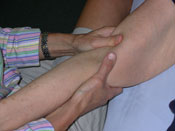
A Certified Structural Integration Practitioner will assess their client’s posture, structural alignments, and movement patterns. In some instances, they will do a detailed assessment of the joint range of motion in many areas of the body.
After assessing the client, the practitioners will use a variety of techniques (such as MFR, STM and NMR) to assist in creating level pelvis and shoulder girdles; to create a stable base for the spine and head when standing and sitting; to realign the soft tissues of the thigh, leg and foot to ease tension around the hip, knee and ankle joints, and to improve the mobility of the entire spine and of the arms/shoulders.
Once mobility has been restored, the practitioner will teach the client how to improve their movement patterns, to better utilize the joints and create ease in everyday activities and chores.
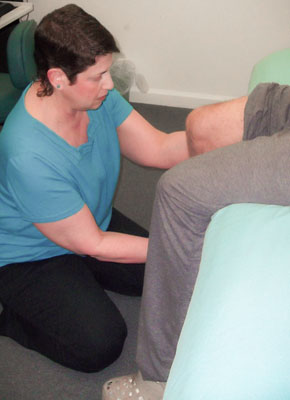
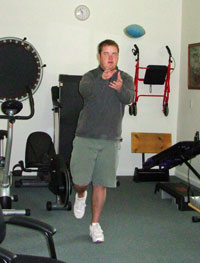
Therapeutic Exercise: Activities led by or taught to you by the Physical Therapist to help you gain strength, flexibility and coordination/balance. In Physical Therapy, these often include Coordination Activities; Stability Training and Core Strengthening.
Trager Method of Neuromuscular Reeducation: Developed by Milton Trager, the Trager Method (www.trager.com) involves a certified practitioner manually applying a series of passive, rhythmic rocking movements to areas of a client’s body, while they lie on a massage-type treatment table. These rocking movements range from gentle to vigorous, and are used to free up restrictions in the soft tissues of the body (muscles, fascia, tendons, etc.), while effortlessly teaching the body to allow movement through areas that it was previously holding tightly. Most clients experience these movements as soothing, non-invasive and relaxing. The overall goal is for the client to experience light, pain-free and fluid movement in their daily life, and to develop an increased awareness of how to move through space with ease and grace.
Visceral Manipulation (VM): This hands-on technique is taught extensively in the US by Dr. Jean-Pierre Barral, DO, through the Barral Institute. (link: www.barralinstitute.com) Practitioners trained in this technique are experienced in finding restrictions in the fascial support structures of the body’s viscera (organs, nerves and vessels). These fascial support structures are used by the body to suspend the organs from the skeleton, and, like ligaments and tendons, can be injured in falls, auto accidents and illnesses. A skilled VM practitioner uses Osteopathic Listening Technique and Manual Thermal Diagnosis Technique, along with range of motion and postural assessments, to find and treat these specialized soft tissue restrictions.